This is the first post in a short data series where we take one of the most competitive keywords in personal injury, "car accident lawyer," and ask a simple question: how do you actually rank for it? Instead of guessing, we pulled the numbers.
Every personal injury firm we talk to wants to know the same thing: what does it really take to land on the first page for "car accident lawyer"? It's one of the most valuable and most contested phrases in legal marketing, and it's surrounded by more opinion than evidence.
So we gathered the evidence. We pulled the top 10 organic results for "car accident lawyer" across the 50 largest U.S. cities, then scrubbed out the directory and forum listings that would otherwise skew the picture. That left us with a clean look at the actual law firm websites competing for these spots, and a way to test the metric everyone asks about first: Domain Rating.
Domain Rating (DR) is a 0-to-100 score that estimates the strength of a website's backlink profile, essentially, how many other credible sites link to it and how authoritative those links are. It's one of the most widely cited proxies for a site's overall "authority." The common assumption is straightforward: the higher your DR, the higher you rank. We wanted to see how true that actually is.
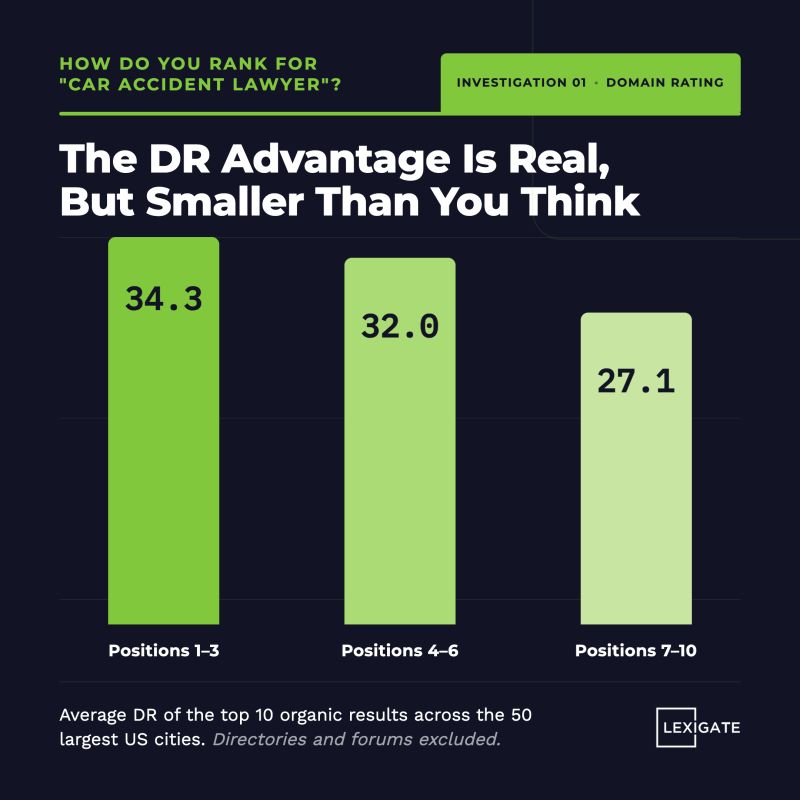
When we averaged Domain Rating by ranking position, a clear pattern emerged. The firms sitting at the very top of page one tend to have stronger, more-trusted domains than the firms clinging to the bottom of it:
The gradient is unmistakable. Authority helps, and the drop-off toward the back half of page one is real. If two firms are otherwise comparable, the one with the stronger domain has a meaningful edge.
Here's the part that surprised even us: the correlation is looser than the headline numbers suggest. A three-point spread between the top and middle of the page isn't a chasm, it's a nudge. And when we looked case by case, we found plenty of firms ranking in positions 1–3 with a DR in the low 30s or below, sitting directly alongside competitors with far larger link profiles.
Building domain authority clearly helps you compete for the top of the page. But it's a contributing factor, not a cheat code.
In other words, a high DR won't carry a weak site to the top on its own, and a modest DR won't keep a genuinely strong, relevant site off page one. If Domain Rating were the whole story, the ranking order would look far cleaner than it does.
Two things are true at once. Building domain authority is worth doing, it's one of the levers that separates the top of the page from the bottom, and ignoring it hands an advantage to competitors who don't. But it is not the lever. The firms winning these spots are almost always getting a lot of other things right too: relevant, well-structured content, a genuinely local presence, real reviews, and pages built to answer the questions injured people are actually asking.
Chasing DR in isolation is how firms end up paying for links and wondering why the rankings never move. The better approach is to build authority as one part of a broader strategy, not as a shortcut around the rest of it.
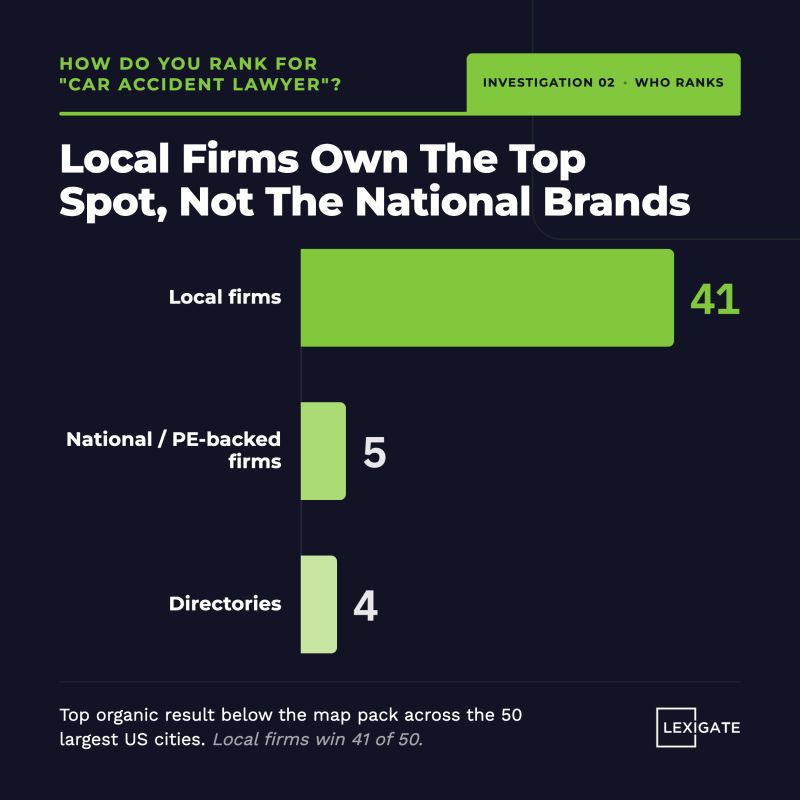
If DR only tells part of the story, what tells the rest? In the next post, we look at who actually wins these rankings, national brands with the biggest budgets, or local firms, and the answer runs counter to what most firm owners expect. Read it here →
Let's talk about building the authority, relevance, and local presence it takes to win the rankings that send you signed cases.