
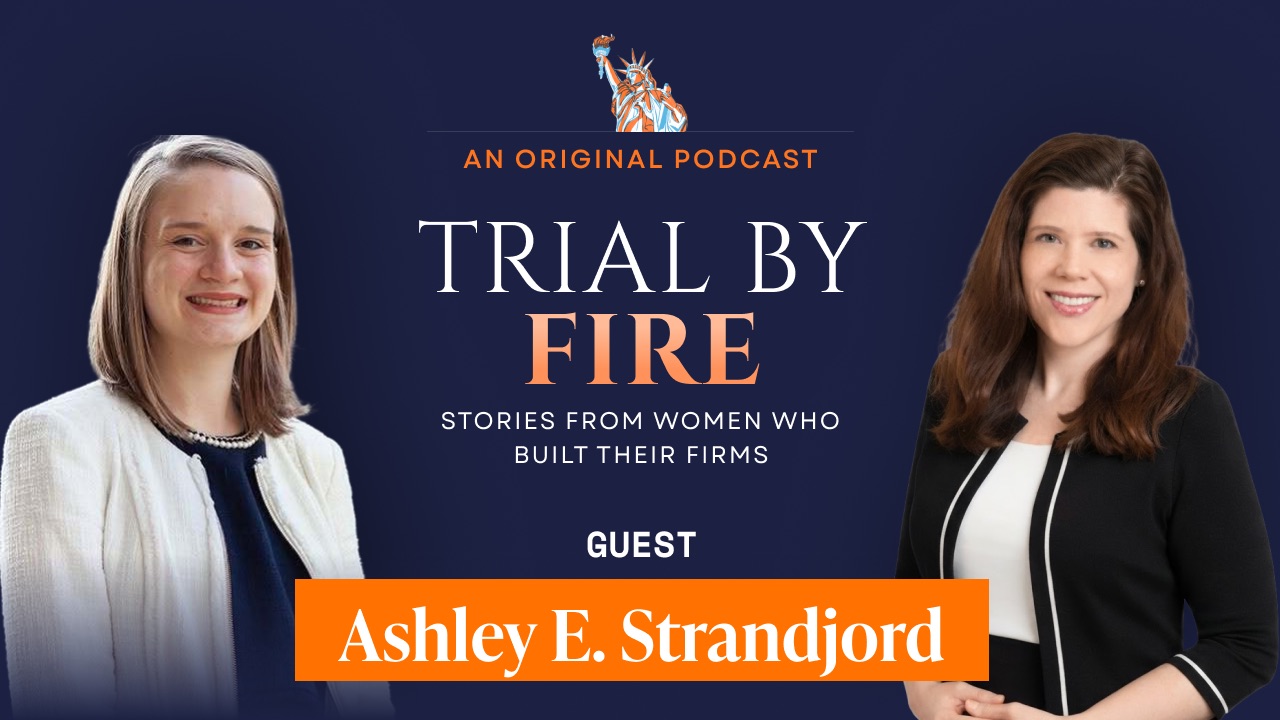
Trial by Fire / Episode 10
In this episode, Ashley Strandjord, partner and personal injury attorney at the Law Offices of Richard J. Serpe, P.C., shares how a legal career that began at just 16 years old developed through mentorship, courtroom experience, and a willingness to take on difficult challenges. Ashley and Julia discuss the mentors who trusted her with real responsibility early in her career, how she built a practice handling personal injury and workers' compensation matters, and why some of the most meaningful advocacy goes beyond securing a financial recovery. Ashley shares stories about dog bite cases, a pro bono case she took because she believed someone needed help, and a client whose resilience after losing a leg changed the way Ashley approached future cases. They also talk about authenticity, building relationships in the legal profession, the less glamorous realities of managing the business side of a practice, and Ashley's advice to young lawyers: trust yourself, do the hard things, and do them often.
Julia: You started working in a law firm at just 16 years old. How did you find your way into the legal world so early?
Ashley: It actually started with a trip to the Kennedy Space Center when I was in eighth grade. I came home convinced I was going to be an aerospace engineer until I found out how much math was involved.
That summer, my mom gave me The Firm by John Grisham. Very stereotypical, I know, but I read it and fell in love with the idea of becoming a lawyer.
We were living in Connecticut at the time, and our neighbor across the street was a partner at a medical malpractice defense firm in Westchester County, New York. He knew I wanted to become an attorney and told my parents that if I really wanted to know whether law was for me, I could work at his firm.
And they put me to work.
That summer, the firm took on a large toxic tort matter involving multidistrict litigation. I kept returning every summer and during breaks through college. I have never worked retail. I have basically always worked in law firms, and I loved it.
Julia: Once you were actually inside a law firm, what made you want to keep coming back?
Ashley: I loved seeing the hearings, depositions, and trials.
The partner I worked most closely with would take me with him and treat me the way he might treat a law school summer associate, even though I was still in high school.
I loved watching what attorneys could do in a courtroom. Whether someone was representing a hospital or a plaintiff, I was fascinated by the process and the opportunity to advocate for someone.
I was soaking it all in, and I knew that was what I wanted to do.
Julia: Mentorship seems to have been a major part of your career. How has it shaped you?
Ashley: I have been incredibly fortunate with mentors.
The first attorney I worked for brought me everywhere. He showed me how cases were prepared, what happened in court, and what it looked like when someone genuinely loved practicing law.
In law school, I worked as a guardian ad litem and with a court administrator who taught me how to prepare reports, present myself in court, deal with difficult situations, and advocate for someone even before I had a law license.
Later, I worked with the New York Attorney General's Office under another great mentor. He was determined that I was going to get courtroom experience.
I remember one of my first habeas corpus matters. He told me to get in his car because I was going to watch him handle the case. We got to court, waited for the case to be called, and when it was, he handed me the file and essentially told me to do it.
I thought I was there to watch.
Afterward, he asked if I had been terrified. I told him no. I thought it was great.
Not long after that, I was sent to Attica for another habeas matter. I was sitting with the inmate while the judge appeared by video. This was around 2014, long before appearing in court by video became normal.
Later, I moved to a firm in Maryland and worked with another tremendous law partner for about seven and a half years. He taught me courtroom finesse. You can know the rules and the procedure, but you also have to learn how to speak to a jury and how to carry yourself in a courtroom.
Eventually, our relationship reached the point where, during a closing argument in one trial, I nudged him and told him he needed to object. He stood up, asked to approach the judge, then turned around and basically asked me what he was objecting to.
That kind of trust is wonderful.
Now I work with Richard Serpe in Norfolk, and I still have that mentorship. I can call Richard with a difficult situation and ask for his perspective. He has been there and done it, and sometimes he can make a problem that feels enormous seem very manageable.
Julia: Your practice includes matters that can involve both workers' compensation and personal injury. How did you develop that combination?
Ashley: I was sort of thrown into it.
At my previous firm, they handled both workers' compensation and personal injury. I came in assuming I would focus on negligence and personal injury because that was what I knew.
Then they told me I was going to do both.
I had little kids at home, and suddenly I was learning an entirely new area of law. But they trained me, and I discovered that I really enjoyed it.
When someone is injured at work, and a third party is also responsible, I can help with both sides. Workers' compensation may address medical benefits, lost wages, and permanent injury while I build the third-party personal injury case.
The client also gets the benefit of having one attorney who understands the whole situation.
There can be liens and other considerations between the cases, so I can look at everything together and help the client decide what makes the most sense. Sometimes that means resolving the third-party case while leaving the workers' compensation matter open. Sometimes it means resolving portions of both.
It requires creative problem-solving, and there is also a lot of client support involved.
Julia: You also handle quite a few dog bite cases. You have talked about how a dog bite case can have an impact beyond one individual claim. What do you mean by that?
Ashley: Virginia does not have strict liability for dog bites, so the fact that a dog bit someone does not automatically mean that person will receive compensation.
But reporting the bite still matters.
Even if a dog does not have a known history of aggression, I tell people to report the incident and speak with animal control. They may also need to determine whether rabies treatment is necessary.
Reporting what happened creates a record. If the dog later gets loose and bites another person or attacks another animal, that history can become important.
You are not only thinking about your own case. You may be protecting the next person and the broader community.
Julia: You had one situation involving a dog attack where you decided to take a case outside your normal practice. What happened?
Ashley: Dog-on-dog attacks can be particularly difficult because the law generally treats animals as property.
I received a call from a family whose dog had been attacked. They had around $18,000 in veterinary bills. They had followed the advice they were given, gone to the magistrate, and pursued the available options. Still, the Commonwealth Attorney's Office was not going to prosecute the matter for them.
I remember thinking that the situation was insane.
It was not really my practice area, although it was adjacent to what I do. But I felt very strongly that someone needed to help them.
I had prosecutorial experience, so I told them I would take the case pro bono.
We ultimately resolved it at the courthouse. They received the amount needed to cover the veterinary bills plus interest because those expenses had been placed on a credit card.
The family was wonderful. Later, they sent me a gift card to my son's favorite restaurant and told me to take him out to dinner.
Sometimes you have to use your power for good. You went to law school. You have the ability to help somebody. Sometimes spending five or six hours helping a person who really needs it is simply worth doing.
Julia: Are there other cases that have been especially meaningful to you?
Ashley: There are clients who stay with you.
One client was injured while working after she slipped on ice in a parking lot. She suffered significant damage to her knee, but she was initially released from the hospital with a boot on her foot and nothing supporting the knee.
Later, her knee gave out again. Unfortunately, the damage became so severe that she ultimately had to have her leg amputated. It started as a below-the-knee amputation, became infected, and eventually became an above-the-knee amputation.
It was horrific.
We fought through the workers' compensation issues and were able to obtain important support for her, including modifications to her home and assistance learning how to drive without a leg.
But what really stays with me is her resilience.
She had begun a weight-loss journey before the accident, and even after losing her leg, she was determined to stay active. She told me she needed to get out, exercise, and meet other athletes with disabilities.
I contacted the carrier and explained that there were adaptive activities in the area, but she needed transportation and support to participate.
We got it approved.
She started rowing, and before I knew it, she was being recruited for a competitive athletic program. Later, she traveled to Israel and sent me a photo of herself hiking with the prosthetic device we had fought to obtain.
I printed that photo immediately.
It was incredible to see. She was in the best shape of her life and doing things that seemed unimaginable when the case began.
That case also taught me an enormous amount as an attorney. It was my first amputation case, although it did not begin as one. I had to ask for help, rely on mentors, and learn alongside my client.
By the time another amputation case came through the door, I understood much more about what the client might need and what questions I should be asking.
Julia: You come across as someone who is very authentically yourself, whether that is with clients, colleagues, or even on LinkedIn. Is that intentional?
Ashley: I think I show up the same way everywhere I go. At least I hope I do.
If you meet me at a CLE, pumping gas, or standing in a rental car line at an airport, you are probably going to get the same version of me.
I was at LAX recently, and my husband sent me to pick up the rental car while he handled something else. I came back about an hour later, and he wanted to know why it had taken me so long.
Well, first, it was LAX.
But I had also met some attorneys in line. We had started talking, exchanged information, connected on LinkedIn, and learned about one another's practices.
My husband said, "You were supposed to get a car, and you met people?"
Yes. Absolutely.
That happens to me all the time. I have met people at CLEs because I made some comment under my breath, and years later we are still friends.
I just show up as myself. Whether you like me or not, you are going to get me. And whether you ask for my opinion or not, you might get that too.
Julia: What has been one of the biggest challenges on the business side of practicing law?
Ashley: Going from a firm where so much was handled behind the scenes to suddenly being responsible for those things myself was a huge adjustment.
At a larger firm, someone has already chosen the case management system. There are processes for CLEs, disbursing checks, insurance, and everything else.
Then suddenly I had to understand operating accounts, IOLTA accounts, bookkeeping, insurance, retirement plans, and all of these other responsibilities.
There were nights when I would wake up at 3 a.m. convinced I had somehow blown a statute or accidentally moved money into the wrong account.
The biggest challenge is figuring out what you do not know and finding the right people to have in your corner.
Partnering with Richard has been fantastic because I can lean on his experience. He might call me and say it is time to talk about malpractice insurance, healthcare, or the 401(k), and I am thinking, "Right. That is another business thing we have to do."
He makes those conversations understandable.
But there is always that question: What else don't I know?
I recently shared that I had reached a million dollars in client benefits recovered since becoming responsible for my own book of business. I was very excited and told my husband.
I was expecting congratulations.
My husband is a tax attorney, so instead he looked at me and said, "I think you have to start paying quarterly taxes."
Not exactly the celebration I was expecting.
Then he started asking whether I knew how much I had spent compared with what I had brought in and whether I had run a profit-and-loss report.
I told him I barely knew about quarterly taxes five minutes earlier.
Those are the kinds of lessons nobody necessarily tells you about before you become responsible for the business.
Julia: If you could go back and give your 16-year-old self one piece of advice about the career ahead of her, what would you say?
Ashley: Have far more confidence in yourself. Do the trial, have faith in yourself, and show up as yourself. Present your client's story the way you believe it should be presented and be true to who you are.
Most importantly, do the hard things and do them often. Doors will open for you. That is probably the best advice I could give my 16-year-old self.
Law Offices of Richard J. Serpe, P.C.
Ashley Strandjord is a personal injury attorney with the Law Offices of Richard J. Serpe, P.C. in Virginia. Her legal career began at just 16 years old, giving her an early foundation in the profession and a lasting commitment to advocacy. Today, Ashley represents clients in personal injury matters, including motor vehicle accidents, dog bites, premises liability, and wrongful death. Her work is grounded in strong preparation, clear communication, and helping clients go through some of the most difficult moments of their lives.
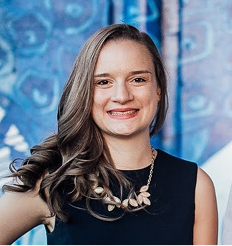
Host · CEO of Lexigate & Repspert
Julia Hensel is the host of Trial by Fire and the CEO of both Lexigate and Repspert, two companies built around helping law firms grow and thrive. She spends her days thinking about what makes a practice succeed, from the business side to the people behind it, and that work has given her a deep admiration for the women who take ownership. That admiration is what sparked this podcast. Trial by Fire is her space to sit down with women lawyers, hear their stories, and celebrate the grit, wisdom, and quiet courage it takes to build something on your own terms.
 Episode 14
Maria Levanoff
 Episode 13
Shira Katz Scanlon
Trial by Fire features women who built their own firms. If that's you, we'd love to talk.
Be a guest