
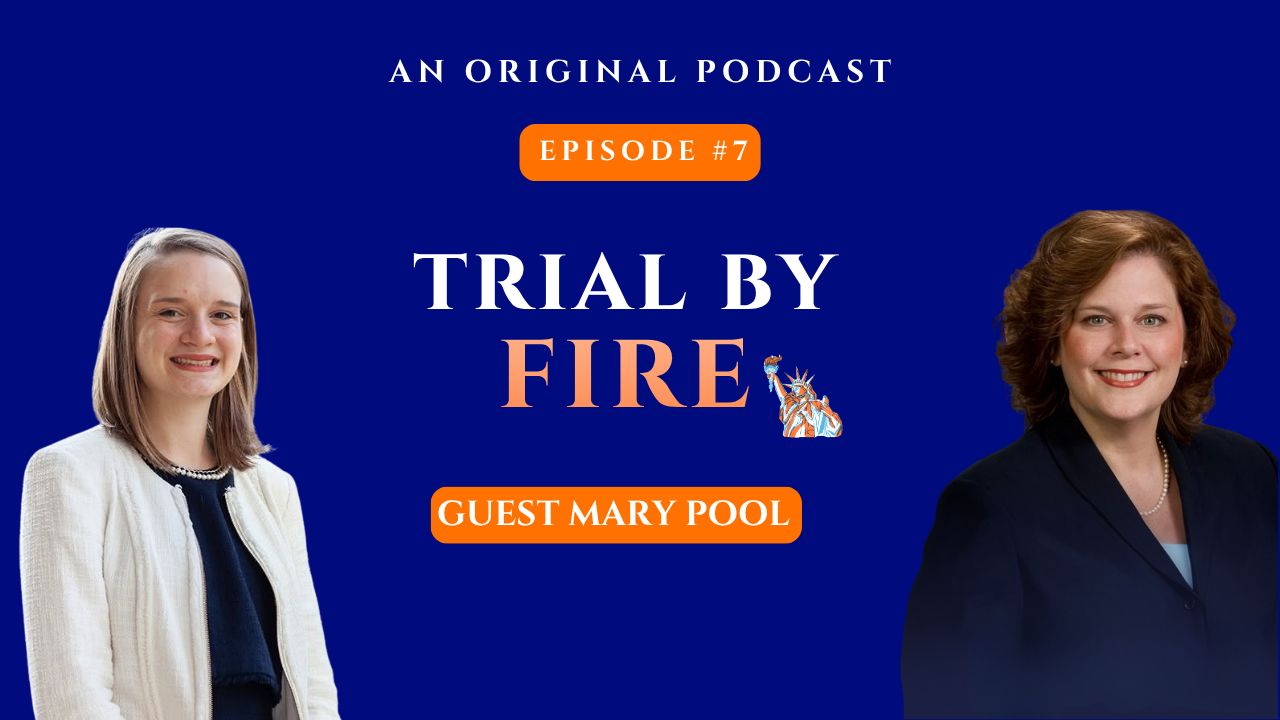
Trial by Fire / Episode 7
In this episode, Mary Pool shares her journey from the financial industry to becoming a successful bankruptcy attorney. Drawing on her background in finance, she explains how helping individuals and families overcome debt became her life's work. Mary discusses the evolution of bankruptcy law, the importance of clear client communication, and how technology, including AI, is transforming the way law firms operate. She also offers practical financial advice, reflects on building a sustainable legal practice, and shares why maintaining healthy boundaries is essential for long-term success.
Julia: You spent almost 20 years in the financial industry before becoming a lawyer. What did you learn there that you have carried with you to the other side of the table?
Mary: I originally started as a debt collector. Back then, we would actually go to people’s homes and make field calls to try to collect debts. From there, I transitioned into banking when I moved to Montgomery, Alabama.
I started as a commercial lending assistant and eventually worked my way up to marketing manager and loan product manager for a national bank. By that point, the bank had acquired institutions in several states.
I learned the financial industry from beginning to end. I knew how debts were collected, but I also understood how people got into debt in the first place. Part of my job was creating loan products that would attract people to our bank.
Eventually, I decided to go to law school. I had met my husband, who was a lawyer, and his father was also a lawyer. They were general practitioners who did a lot of criminal work.
One day, my husband asked me to organize a file for him because I was a little more organized than he was. I started going through everything and realized the person had not even been charged correctly and that some of the evidence did not support the charge.
I knew nothing about practicing law, but I started pointing these things out to my husband. He looked at it and said, “You’re right.”
I remember thinking, “If he can do this, I know I can do this.”
That was what inspired me to go to law school.
I was doing very well at the bank and did not have a financial reason to change careers. I simply discovered something else I wanted to do.
From the beginning of law school, I knew I wanted whatever I practiced to involve finances. I had no interest in criminal law or personal injury. My husband and father-in-law probably would have welcomed me into their practice, but I learned pretty quickly that my husband and I do much better at home than we would working together.
In 2008, I interviewed with Gil Donaldson, our managing partner at Bond & Botes. Interestingly, she had started as a legal assistant or receptionist and worked her way up as well.
We discovered that we had actually worked in the same building years earlier when I was at the bank without ever knowing each other.
She took a chance on me, gave me a job, and everything grew from there.
I have now helped a lot of people get out of debt, and I have to say I prefer this side of the financial world. There is so much joy in watching someone finally experience relief and peace.
Finances can cause divorces, family problems, depression, and sometimes even worse consequences. If I can help somebody get out of debt or at least understand what options they have, I feel like I have done something worthwhile.
Julia: What have been some of the most meaningful clients or experiences you have had throughout your career?
Mary: There are so many, but some of the hardest cases for me involve people who are already past retirement age and trying to survive on a fixed income.
They may have worked hard their entire lives and paid most of their mortgage, but their income only stretches so far. Then they come into my office saying, “I’m trying to save my car. I’m trying to save my house.”
Trying to create a budget that works on a fixed income can be extremely difficult.
But those clients will often do everything in their power to complete their Chapter 13 plan or make a Chapter 7 case work. When I am finally able to give them their discharge, there is nothing better.
It is especially meaningful because someone in retirement cannot necessarily say, “I’ll just go get another job and make more money.”
I have also represented people who lost a spouse and suddenly had to figure out how to survive on one income.
Then there are clients dealing with cancer or other serious medical conditions. If someone calls and tells me what they are going through, I will pray with them over the phone. I tell them they are on my prayer list and that we are going to do everything we can.
When somebody is dealing with a medical crisis, they need to be able to focus on healing. It is hard to do that when debt collectors are calling every night or when you are wondering whether you can pay a bill or feed your children.
Financial problems can make people feel like failures.
Part of my job is reminding them that they are not failures. Many of them struggled for five or ten years before they finally came to see me.
I often tell them, “You should have come earlier. You could have been sleeping all these years.”
Then they tell me, “I can’t believe how good I feel now.”
There is almost a higher calling involved in this kind of work. You can physically feel the stress leaving the room when a client realizes the creditors cannot keep harassing them and they can finally focus on their family again.
Julia: Are there other types of cases that have been especially rewarding?
Mary: One area that has been particularly rewarding recently involves student loans.
A lot of people believe student loans can never be discharged in bankruptcy. That is not completely accurate.
There are circumstances now where we may be able to help someone who has carried student-loan debt for 20 years finally get relief.
Being able to call a client and say, “Those student loans that have been on your back for 20 years are gone,” is an incredible feeling.
It makes me feel good to know that I can use my experience to make a meaningful difference in somebody’s life.
Julia: How important is communication when you are helping clients through such a stressful process?
Mary: Information is key.
Attorneys sometimes get a bad reputation because clients feel as though nobody is calling them or keeping them informed. Sometimes the reality is that if I called you every single time something happened in your case, I might make you more stressed.
Part of my job is to carry some of that burden for you. If I am calling, ideally it is because I have good news or because there is something we genuinely need to discuss.
But you need a good system that allows clients to communicate with you when they need to.
You do not want somebody lying awake at night thinking, “She didn’t call me back. I need to talk to her.”
Give people multiple ways to reach you so they know they are not being ignored.
Julia: Do you have any tips for staying organized and remembering to follow up with clients?
Mary: We use Clio, and it has an excellent client portal.
Once we file a case, we can open the portal so the client can communicate directly with me and access documents from the bankruptcy case.
That means they are not constantly wondering, “How much was my payment? When is it due? How do I make it?”
They can go back to one central place and find that information.
I also do not hide my direct number from clients. I treat my clients like family, and I feel that if they cannot reach me when they genuinely need me, I am not doing my job.
For follow-ups, I use Clio’s task features. If I need a tax return for the trustee or have a deadline for responding to a motion, I create a task that tells me exactly what I need to do and when.
That system helps me stay very organized.
I do not schedule an appointment every time a client wants to talk. Often, a simple phone call is enough to give someone peace of mind.
But if a client says, “I really need to come see you in person,” I will make time for them.
Julia: What have been some of the toughest things to learn on the business-management side of running a law practice?
Mary: Law school does not necessarily prepare you for practice management.
I went to Jones School of Law, and I was part of the first class to graduate after the school became accredited. They tried to provide practice-management education, but there is only so much you can learn in a classroom.
Maybe that is why they call it practicing law.
Until you are actually running a practice and dealing with the details every day, it is difficult to know exactly what will work for your firm.
There is no cookie-cutter approach.
One person may be very visual. Another may love paper. Someone else may want everything to be completely digital.
The challenge is finding systems that can work for different personalities while still keeping the firm organized.
That has involved a lot of trial and error for us.
We originally used software that almost every bankruptcy firm relied on to prepare petitions. At the time, it seemed like the only option.
Over the years, more products entered the market, and we started experimenting with different systems.
Since I have been here, I think we are now on our third client-practice-management system and our second, or technically third, petition-management platform.
I actually enjoy testing software. I like getting into a system and figuring out how we can make things faster and easier for our clients.
The harder part is implementation.
You have to determine the right workflow for your particular firm.
The best way I have found to do that is to stay flexible and communicate with your staff. Ask them what is working and what is not.
You cannot be so convinced that your way is correct that you refuse to change it.
If your staff is struggling with a system, you need to listen and figure out what challenges they are having.
Julia: How have your experiences with technology changed the way you think about new systems?
Mary: I remember when the bank first moved from paper to computers.
I had been doing paper tickets for everything, and suddenly there was a computer sitting on my desk. I was resistant to it.
I remember thinking, “Why am I using this? I’m faster than this machine.”
And at that point, I probably was.
But once I got past that resistance, I realized how much more work I could process.
I have seen the same thing happen with people at the law firm. One of my law partners wanted everything on paper. It was files, files, files.
Then she realized she could access everything electronically, have backups, and stop pulling 20 different files onto her desk.
Now her desk is clean, and she loves it.
People may resist change at first. The important thing is being committed to the process, allowing staff to express their frustrations, and helping them get comfortable with the new system.
Julia: What conversations is your firm having about AI?
Mary: I am not opposed to AI, and neither is our bar association as long as we are complying with our ethical obligations.
I would never share confidential client information.
But I might use AI to help identify possible research directions. I could explain the type of problem I am trying to solve and ask whether there are cases that might be relevant.
Then I go directly to those cases and confirm everything myself.
I would never simply allow AI to write my legal work for me. Writing is one of the parts of being an attorney that I enjoy, and I take pride in what I produce.
But I do use several AI tools. I use Perplexity, ChatGPT, and other platforms that help us gather and review information.
We also use technology to make document collection easier for clients through secure portals.
One area where AI can be especially useful is analyzing financial documents.
In bankruptcy, we have to determine where clients are spending their money and calculate realistic averages.
Clients often do not know.
I did that exercise myself once. There are three people in our household, and when I actually added everything up, I realized we were spending around $1,300 a month on food.
If you had asked me beforehand, I probably would have guessed $500 or $600.
But then you look at groceries, DoorDash, eating out, and all the small purchases, and suddenly it adds up.
Technology can help people see those patterns much more clearly.
Julia: Having seen the financial world from both sides, what advice do you give individuals or small-business owners about managing their finances?
Mary: The number-one thing is to live within your means.
Dave Ramsey has a saying I have always liked: live today like no one else so you can live tomorrow like no one else.
We live in a world where people are constantly trying to keep up with everyone around them. They want the newest car, the newest thing, or whatever somebody else has.
I drive carpool for my daughter, and the girls will ask me, “Miss Mary, when are you going to buy a new car?”
I tell them, “I haven’t had a car payment in years, and I love my car.”
There is a lot of freedom in not constantly needing the newest thing.
The second thing I would say is that it is never too early to teach children about finances.
Do not completely hide your financial mistakes from your children either.
Obviously, everything needs to be age-appropriate. You do not want a child terrified that the family has no money.
But children should understand that adults make financial mistakes too, and that making a mistake does not mean your future is ruined.
Today you may be struggling, but that does not mean you will always be struggling.
I tell my bankruptcy clients the same thing. If you are in a Chapter 13 plan, follow the plan and make your payments.
Then, three to five years later, when I hand you that discharge and all that money is freed up, use the opportunity wisely.
Build a budget. Start putting money aside. Create something for a rainy day.
And never let creditors bully you.
I used to be a debt collector. I know the tricks.
Clients will sometimes tell me, “They said I’m going to be arrested.”
I tell them to understand the law in their state and speak with a qualified attorney if they are frightened or unsure.
Many bankruptcy attorneys offer free consultations.
Do not simply take financial or legal advice from the debt collector who is trying to collect money from you.
I received bonuses based on what I collected. Debt collectors have a financial interest in convincing you to pay them.
Julia: How are you teaching your own daughter about money?
Mary: My daughter is 12, so we are working on that now.
She has an allowance, and we are starting to tell her that if there is a luxury item she wants, Mom and Dad are not automatically buying it anymore.
She has to save for it.
Like most 12-year-olds, she wants things immediately.
So part of the lesson is simply learning, “I cannot buy this this week. I may have to wait another week.”
That is an important financial lesson by itself.
Julia: Do you believe in work-life balance? What does that look like for you?
Mary: I absolutely do.
It can be difficult depending on your practice. I treat my clients like family, and I certainly do not have traditional banking hours.
But there are times when I have to put my phone on Do Not Disturb because that is in the best interest of my child and my family.
Those are boundaries you have to set for yourself.
There is not one formula that works for everyone. You have to determine what your family needs.
If my daughter were struggling in school, for example, I might need to leave earlier so I could help with tutoring or something else she needed.
Fortunately, she is a bright kid and does very well in school.
But I absolutely believe work-life balance is important.
I also think learning to say no is essential.
When you are a new attorney or a new shareholder, people may naturally look at you as the person who is going to do everything.
You want to hustle and prove yourself.
But if you are already doing your job and you genuinely cannot take on anything else, it is okay to say no.
Do not create additional stress in your life when you do not have to.
Your health matters too.
I had my daughter when I was 43, and I have already promised her I am going to live to 104.
So I have to make that happen.
Julia: Do clients understand when you set those boundaries?
Mary: Most of them absolutely do.
It would be different if you ignored someone for weeks at a time.
But very rarely have I had a client become upset because I did not respond immediately.
Most people understand that you have a life outside of work.
As long as you answer their questions and keep communication open, they are appreciative.
I think that open line of communication is one of the reasons I have had such positive relationships with my clients.
Julia: When you think about the next five or ten years, what are you hoping for personally and for the firm?
Mary: I am probably the happiest I have ever been with what I am doing professionally.
Job-wise, I want to continue doing exactly what I am doing today, and I hope that continues to be with Bond & Botes.
I cannot really see myself doing anything different.
I have also had a long career. I have been working since I was 13, so I can see myself working another 11 or 12 years and then retiring.
By then, my daughter should be out of college.
I would love to travel and enjoy that stage of life with my family.
I think it is important to have a goal for retirement.
A lot of attorneys say they are simply going to work until they die.
I have seen what can happen when someone’s entire identity is tied to work. My father-in-law practiced with my husband, and after he retired, he passed away within about a year or a year and a half.
Practicing law had been such a huge part of his life.
I want to enjoy my career, but I also want to enjoy my life and my family.
So I hope to spend the next 11 or 12 years continuing to help people get out of debt and then pass that work on to someone who is just as passionate about helping those clients as I am.
Bond & Botes Law Offices
Mary Pool is a shareholder at The Bond & Botes Law Offices and a bankruptcy attorney whose career began in the financial industry before she transitioned into law. Her firsthand understanding of lending, collections, and personal finance gives her a unique perspective when helping clients go through financial hardship. Throughout her career, Mary has focused on providing practical legal guidance while helping individuals and families regain stability and peace of mind. She is also passionate about improving law firm operations through technology, embracing AI where it can enhance efficiency, and maintaining a healthy balance between a successful legal career and a fulfilling personal life.

Host · CEO of Lexigate & Repspert
Julia Hensel is the host of Trial by Fire and the CEO of both Lexigate and Repspert, two companies built around helping law firms grow and thrive. She spends her days thinking about what makes a practice succeed, from the business side to the people behind it, and that work has given her a deep admiration for the women who take ownership. That admiration is what sparked this podcast. Trial by Fire is her space to sit down with women lawyers, hear their stories, and celebrate the grit, wisdom, and quiet courage it takes to build something on your own terms.
 Episode 13
Shira Katz Scanlon
 Episode 12
Megan Kiefer
Trial by Fire features women who built their own firms. If that's you, we'd love to talk.
Be a guest